Product Announcement
Amazon FSx for NetApp ONTAP is now included in CloudHedge storage assessment and TCO modeling tool
CHAI DART™ now assesses FSx for ONTAP alongside Amazon EBS in the same workflow, so storage becomes a modeled decision in the migration business case.
When planning a VMware or data center migration to Amazon Web Services (AWS), most cost estimates begin with compute: instance counts, families, and sizes. Storage is often treated as an afterthought. For many workloads, that initial choice is never revisited and, because storage is billed every month for the lifetime of the workload, the cost of this decision compounds.
CHAI DART™, the Discovery, Assessment, and Rationalization Tool (DART) in the CloudHedge Agentic Intelligence (CHAI) platform, now assesses Amazon FSx for NetApp ONTAP (FSx for ONTAP) alongside Amazon Elastic Block Store (Amazon EBS) in the same workflow. Storage becomes a modeled decision in the migration business case, enabling the right service to be chosen from the start.
In this post, we explain why storage is so often selected by default rather than being assessed and the costs of that decision over a workload lifetime. We also show how CHAI DART compares that cost and the total cost of ownership (TCO) of Amazon EBS and FSx for ONTAP before you commit and explain how this strengthens the migration business case when combined with AWS Migration Acceleration Program (MAP) funding and licensing optimization.
Why storage gets defaulted and what it costs
Storage is a recurring operational expense. Unlike the one-time effort of migrating a workload, storage costs continue for as long as the workload runs. As a result, a sizing decision made quickly during the assessment phase can affect costs for years to come.
When storage is assumed rather than properly assessed, the consequences tend to fall into four categories:
- Storage is sized without workload data. With no assessment of the capacity, IOPS, and throughput each volume needs, storage is often provisioned for the worst-case scenario. The result is excess capacity that sits idle, while continuing to generate costs.
- One default is applied across different workloads. File shares, databases, and application tiers have different access patterns. A single storage default is unlikely to be the best fit for all of them.
- The baseline isn't optimal from day one. An approved business case is built on assessment data. If storage sizing relies on default assumptions, rather than workload-specific analysis, the TCO baseline is wrong from the start. When gaps surface later, correcting them is more complex and costly.
- Better-fit options stay invisible. A default choice means there's no visibility of other options that might be more suitable. Workloads that would run better and cost less are simply never considered. While Amazon EBS is the right fit for many enterprise use cases, every workload should be evaluated individually to determine the most appropriate storage solution.
What's new in CHAI DART
CHAI DART already models the TCO of AWS migrations. It now extends this capability to evaluating FSx for ONTAP alongside Amazon EBS in the same assessment and business-case workflow, providing:
- Cost comparison. The costs of Amazon EBS and FSx for ONTAP are compared side by side for each workload.
- TCO modeling. The long-term cost difference is quantified before you commit to a decision.
- Business-case modeling. Storage is folded into the migration business case with real numbers rather than assumptions.
- Storage recommendation. FSx for ONTAP is evaluated as a selectable, data-backed option, not a manual afterthought.
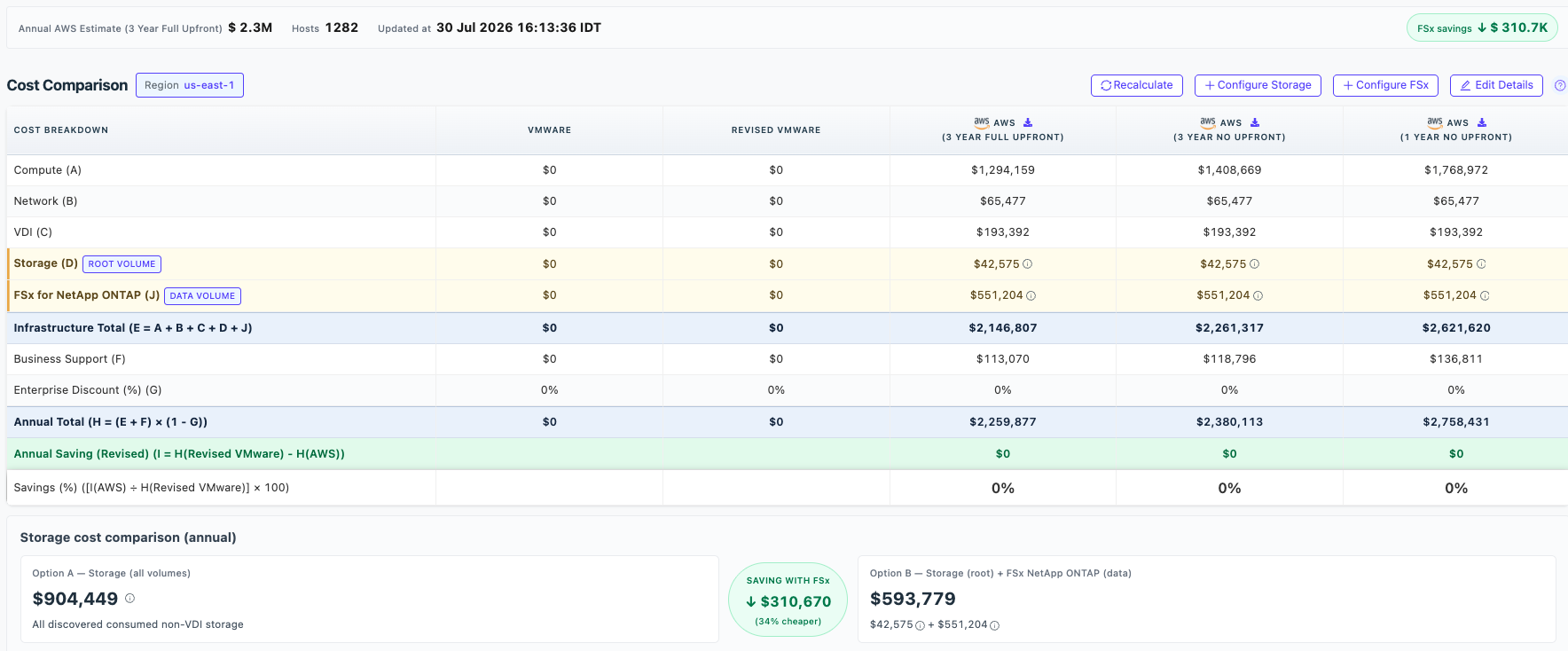
The following screen shows how CHAI DART compares the costs of Amazon EBS and FSx for ONTAP, including any savings, for a sample workload group.
The value of Amazon FSx for NetApp ONTAP
The value of FSx for ONTAP goes beyond reduced storage costs. Its data services unlock additional benefits, including:
- Greater storage efficiency. Inline deduplication, compression, and thin provisioning reduce the capacity you pay for.
- Simplified data protection. Instant, space-efficient snapshots and clones accelerate refresh and recovery cycles compared to per-volume copies, while Autonomous Ransomware Protection (ARP) enhances data protection at no additional cost.
- Flexible data access. Multiprotocol access is available to Network File System (NFS), Server Message Block (SMB), and Amazon Simple Storage Service (Amazon S3), as well as iSCSI and NVMe over TCP for block protocol.
- Rightsized performance. Scalable throughput capacity and provisioned SSD IOPS help align performance with changing workload requirements, reducing overprovisioning and optimizing cost.
FSx for ONTAP is well suited to file and database workloads. It integrates with Amazon Elastic Kubernetes Service (Amazon EKS) and Kubernetes environments, which match the VMware re-host and modernization projects driving migrations today. In practice, the root volume still stays on Amazon EBS while data volumes move to FSx for ONTAP, and that split is where the performance and cost gains lie.
Learn why storage assessment is critical when planning your migration to AWS, in our post.
Strengthening the migration business case
Storage is just one of the levers on migration economics. Funding and licensing offer additional advantages. As an AWS MAP-qualified partner that also delivers AWS Optimization and Licensing Assessments (OLA), CloudHedge helps eligible organizations carrying out VMware and data center migrations to access MAP funding and rightsize licensing, alongside the storage savings surfaced by the assessment. These levers then move the business case in the same direction: a rightsized storage decision, optimized licensing, and AWS investment supporting the move.
With FSx for ONTAP as part of the assessment, you get:
- Migration decisions backed by assessment data, not default values.
- Storage economics that are visible before workloads are deployed.
- Storage that's rightsized to each workload's performance and enterprise requirements.
Getting started
FSx for ONTAP assessment is available today in CHAI DART, extending the platform's existing TCO modeling capabilities. FSx for ONTAP TCO depends on how capacity is provisioned, tiered, and shared across volumes, and CHAI DART models these variables in comparison to the alternatives. As a result, storage decisions that used to get defaulted are now part of every initial business case assessment.
If you're planning a VMware or data center migration to AWS, run an assessment that includes your storage options from the start — not as an afterthought.
To learn more, take a look at the FSx for ONTAP documentation or visit our website cloudhedge.io to schedule a storage assessment today.
Start with an assessment
See what is actually in your estate before you commit to a migration plan.